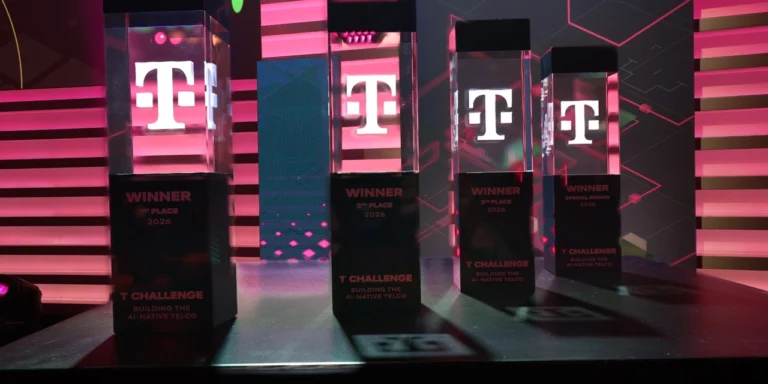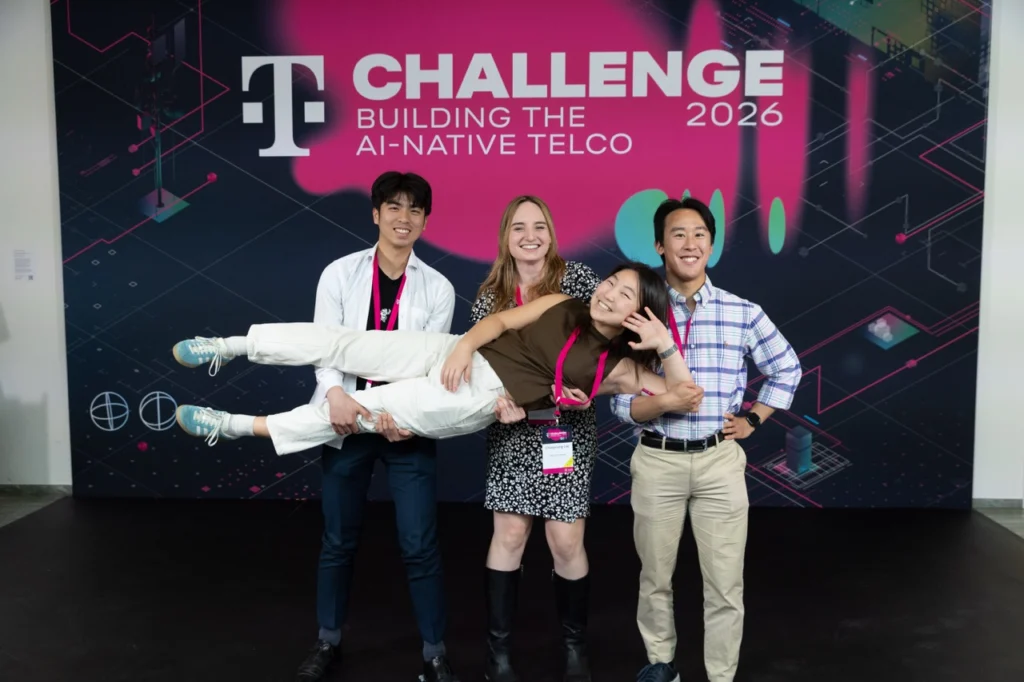
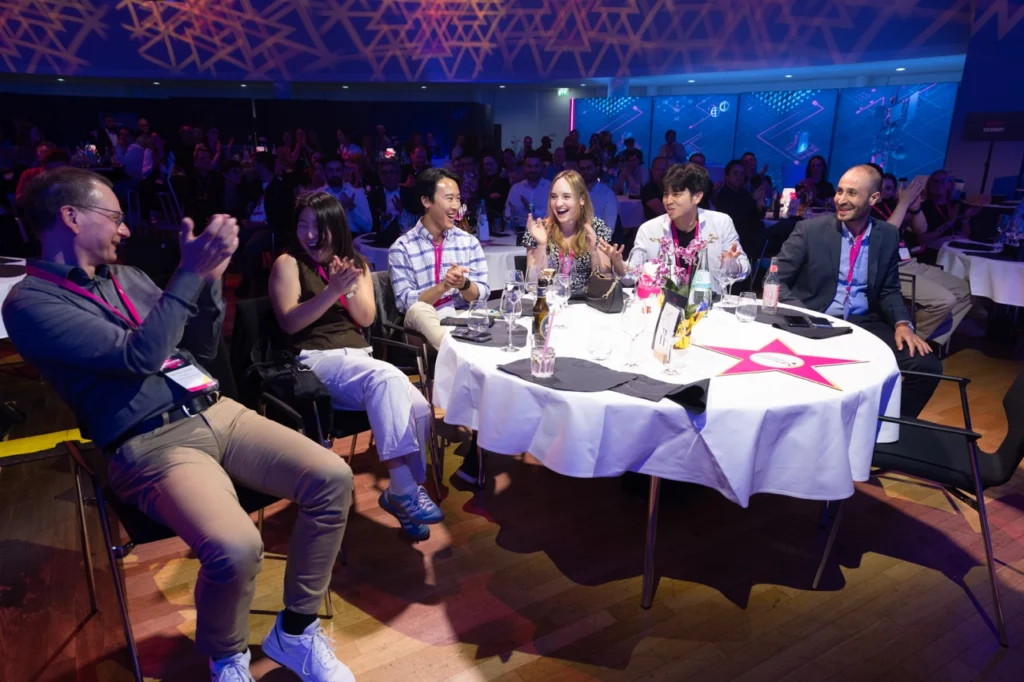
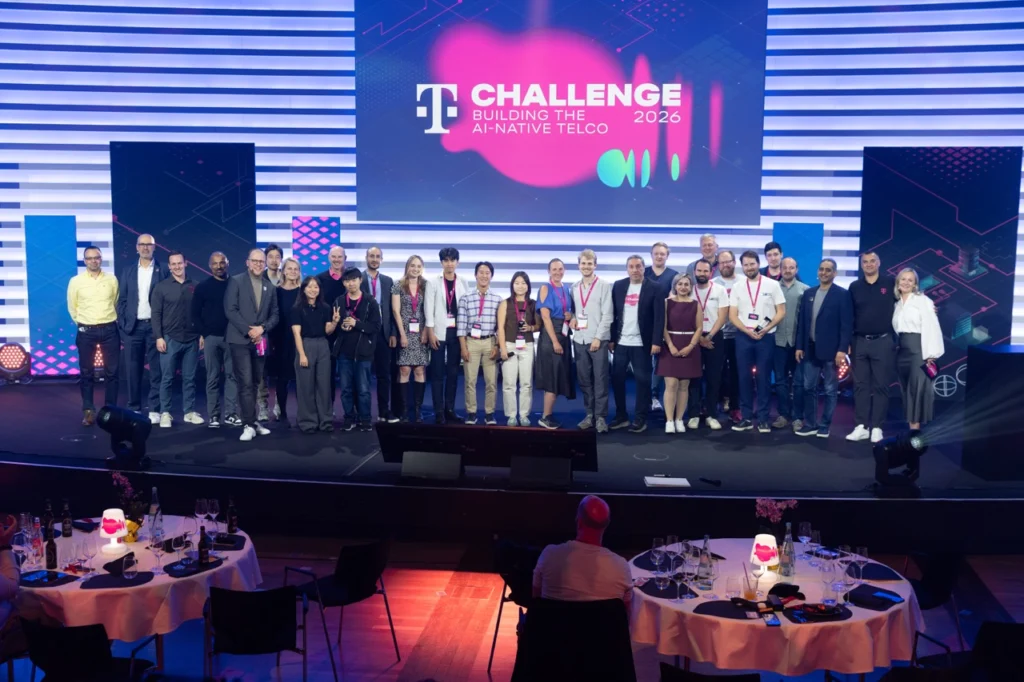
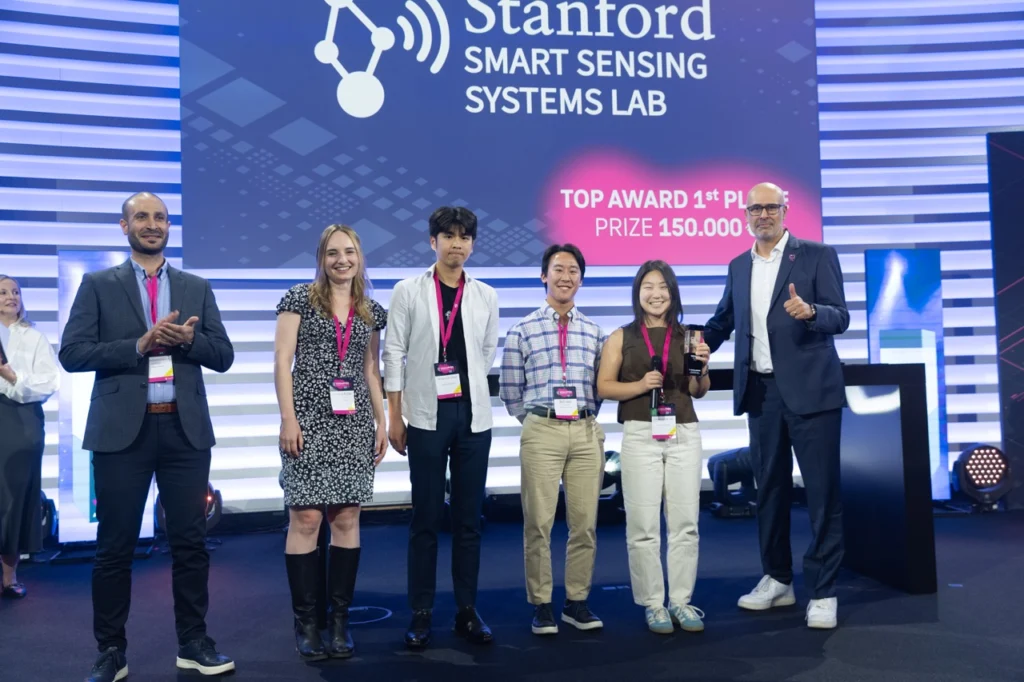
A team of Stanford University students has won the T Challenge Award 2026, outperforming more than 500 global submissions with a novel approach to reducing data transmission in AI-driven telecom networks.
Their solution tackles a growing challenge at the network edge: how to handle vast amounts of data generated by devices such as drones, robots, and sensors. Instead of transmitting everything, their system intelligently selects only the most relevant information – significantly reducing communication load.
At the core of the approach is semantic compression combined with a shared edge-cloud knowledge base, enabling systems to focus on what is new rather than what is repetitive. This makes the solution particularly effective in environments with high data redundancy, such as physical AI and IoT deployments.
With €150,000 in funding and industry recognition, the team is now preparing to move from lab validation to real-world deployment. The winning solutions stood out particularly due to “potentially massive impact on the industry, and cost reduction factor” – said Arash Ashouriha (SVP Group Technology), who presented the award on behalf of Deutsche Telekom.
Below is the full interview with the winners.
Today, we’re seeing a growing number of applications at the edge - robots operating in the field, drones, and sensors deployed in remote areas. These devices collect very valuable data about their environment and the tasks they perform. However, this data is often too large to be efficiently transmitted to the cloud and then to the end user.
Our approach addresses this by intelligently selecting what data to send, instead of transmitting everything. Determining what is worth sending at any given moment is key to significantly reducing communication load.
Many semantic communication methods rely on neural models. These models are very powerful, but they tend to break down when real-world data distributions shift. In our approach, we use a neural model that functions more like human perception - like an eye or an ear - extracting high-level features from the data.
Instead of storing knowledge inside the neural model itself, we store it externally in a vector database. This makes our solution more modular, lightweight, and adaptable to real-world conditions.
Our system uses synchronized databases at both the edge and the cloud. The sender and receiver share this synchronized database. While synchronization might sound expensive, we avoid constantly transmitting large amounts of data.
Instead, when new or previously unseen data appears - something not already in the database - we send the full data to the cloud. That data is then added as a new entry. This way, we maintain synchronization incrementally. We don’t need to sync everything all the time - only the differences.
Yes. Take a wildlife monitoring camera: it might capture deer, coyotes, and then more coyotes - perhaps hundreds of thousands of similar images. There’s little value in sending all of them.
But if something changes - for example, coyotes that are usually active at night suddenly appear during the day- that’s a novel event. In that case, we send the full data. The key is to efficiently distinguish between redundant and novel events using lightweight resources. That’s what enables our system to work effectively in real-world sensing scenarios.
To be frank, it’s not a universal solution. It may not be ideal for general end-user applications. Our approach is based on redundancy. If the data being transmitted contains a lot of repetition, then there is significant potential for optimization.
So rather than generic data use cases, we focus on physical AI systems - robots, drones, and IoT sensors operating in the field. That’s where we see the greatest benefits.
With this funding and recognition, we’re ready to move into real-world deployment. Instead of demonstrating results only on datasets in a lab environment, we want to build working hardware and test the system over extended periods - at least a year or more.
We want to prove that this technology isn’t just theoretical or based on benchmarks, but that it works reliably in dynamic, real-world conditions.